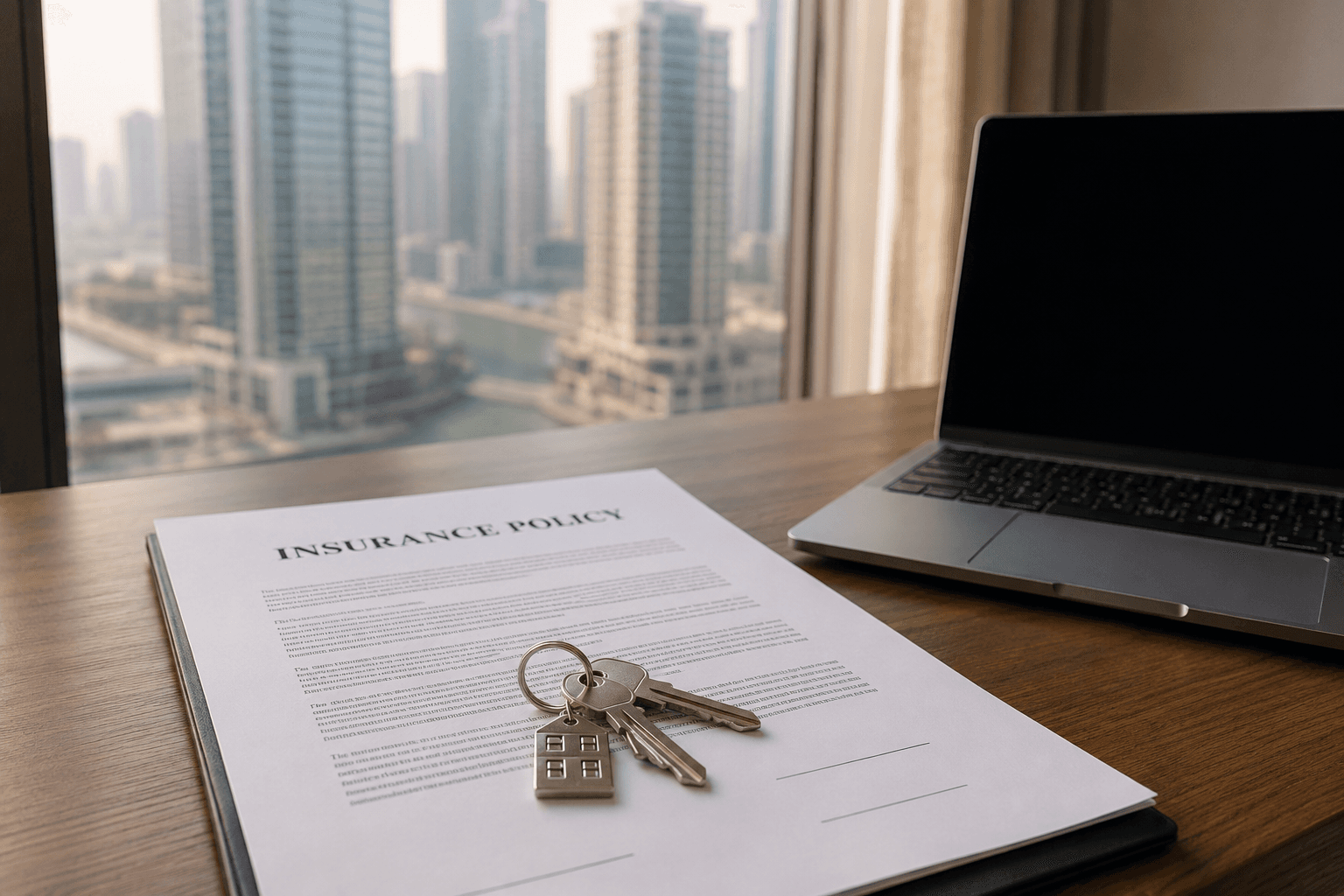
If you're running a Dubai holiday home on the same home insurance policy that came with the apartment, there's a good chance you're operating uninsured and don't know it. Standard buildings and contents policies in the UAE explicitly exclude paying-guest activity — the moment you accept an Airbnb or Booking.com reservation, a standard policy stops covering that stay. This isn't a grey area insurers are quiet about; it's written into the exclusions.
Why Your Existing Home Policy Doesn't Cover This
A standard home insurance policy is priced and underwritten around a single household living in the unit. Paying guests change the risk profile entirely — more turnover, more strangers with access, higher likelihood of an incident — and insurers price that risk differently, or exclude it outright rather than price it into a standard policy. If you let a Dubai property on a short-term platform while holding only a standard home policy, you are uninsured during every one of those bookings, even if the policy is active and premiums are paid up to date.
What DET Actually Requires
The Department of Economy and Tourism requires holiday home permit holders to carry "adequate insurance," without rigidly defining a single mandated policy — but DET inspectors do check for this at permit stage, and permits reference it as an ongoing compliance condition, not a one-time box to tick. In practice, this means a host-rated policy covering:
Buildings insurance — typically already covered under the building's master policy through your Owners' Association; worth confirming rather than assuming.
Contents insurance — covers your furniture, appliances, and fixtures against guest-caused damage; a standard recommendation is coverage of AED 100,000 or more depending on how the unit is furnished.
Public liability insurance — covers injury or damage claims from guests during their stay; typically recommended at AED 1–5 million depending on provider and property size.
Loss of rent insurance — optional but worth having; covers income loss if the property becomes uninhabitable due to an insured event like fire or flood damage.
What It Actually Costs
Host-rated policies in the UAE typically run 1.5–2x the price of an equivalent standard home policy, sold by insurers including GIG Gulf, Sukoon, and Liva, or through specialist brokers. For a like-for-like buildings, contents, and liability stack, current market premiums run roughly AED 1,500 annually for a standard apartment, scaling up toward AED 4,000– 8,000 for larger or premium units, and considerably higher for villas with high-value contents. Operators managing multiple units can typically negotiate portfolio-level rates rather than insuring each unit separately at retail pricing — worth raising directly with a broker once you're past 3–4 properties.
The Cost Sits Alongside Your Other Compliance Costs
Insurance isn't a standalone line item — it sits in the same compliance stack as your DET permit fees, Tourism Dirham collection, and trade license if you're operating beyond a handful of self-managed units. We've broken down the permit side of this in detail in our DET holiday home permit guide, and the tax treatment of STR income in our VAT and corporate tax breakdown — insurance is the third compliance cost that's easy to underbudget because it doesn't show up as a licensing fee with a fixed number attached to it.
What This Means If You're Self-Managing a Single Unit
If you own and self-manage one property, the practical move is contacting a broker directly (Insurance Market and Souqalmal are commonly used comparison routes in the UAE) and specifically requesting a host-rated or short-term-rental-rated quote — not a standard home policy. Be explicit that the property is let on Airbnb or Booking.com; a generic quote request without that detail can come back as a standard policy that won't actually cover you.
Common Questions on Dubai STR Insurance
Does Airbnb's AirCover replace the need for my own insurance policy?
No. AirCover covers guest-caused property damage claims through Airbnb's own process, but it doesn't replace a host-rated liability and buildings/contents policy, and it doesn't apply to direct or Booking.com reservations at all.
Will my existing home insurer just add STR cover as an endorsement?
Some will, some won't — it depends on the insurer and how they classify the risk. Worth asking directly rather than assuming either way, since getting this wrong means an invalid claim if something happens.
Is insurance actually checked, or just a paperwork requirement?
DET references adequate insurance as an ongoing compliance condition tied to the permit, and inspectors check for it at various points — it's not a formality you can skip once the permit is issued.
Does insurance cost scale down per unit as a portfolio grows?
Generally yes — insurers and brokers commonly offer portfolio-level rates once you're managing multiple units, rather than pricing each policy at single-unit retail cost.
Reviewing Your Own Coverage?
If you're unsure whether your current policy actually covers short-term guest activity, it's worth a direct call to your insurer to confirm before your next guest checks in — not after an incident.