If you're worth $10 million or more, you already know the game.
You've built wealth in markets designed to take it from you. Income taxes on rentals. Capital gains on exits. Regulatory changes that shift overnight. Every return you generate gets eroded before you can compound it.
You're constantly engineering around the system—finding loopholes, structuring entities, timing dispositions. It works, but it's exhausting. And it shouldn't be this hard.
This is why serious capital is flowing to Dubai.
Not for speculation. Not for flipping. For something simpler:
tax-free cash flow that compounds without friction.
I'm writing this as an investor with multi-eight-figure holdings across multiple countries. My Dubai portfolio is actually my smallest—but it's my safety net. The one that requires the least mental overhead while delivering the cleanest returns.
Here's the framework I use to generate 10%+ net ROI annually—and why it works specifically for investors at our level.
Why Dubai Works for Wealthy Investors (When Other Markets Don't)
Let me be direct about what Dubai actually offers—and what it doesn't.
Zero Tax on Income and Gains
In most Western markets, a 6-7% gross yield becomes 3-4% after income taxes. When you exit, capital gains take another chunk. You're compounding on half your returns.
Dubai: 0% income tax on rental income. 0% capital gains on sale. What you earn is what you keep.
A 10% net yield in Dubai is genuinely 10%. Not 10% before the government takes their share. That alone changes the math on everything.
USD-Pegged Currency
The UAE dirham is pegged to the US dollar at a fixed rate (3.67 AED = 1 USD). Your returns aren't eroded by currency volatility. You're holding dollar-denominated assets without the complexity of offshore structuring.
For investors from countries with weakening currencies—or anyone who wants hard-asset exposure without forex risk—this is significant.
A System Built for Capital
I won't sugarcoat this: Dubai is a capitalism country. If you have capital, you're treated accordingly. Banks chase you. Government services respond instantly. The entire infrastructure is designed around making wealthy investors comfortable enough to deploy more.
The logic is simple: you're not a citizen. If they treat you poorly, you leave. So everything is engineered to keep you investing.
Is this cynical? Perhaps. Is it effective for investors? Absolutely.
Political Neutrality
Dubai treats everyone equally regardless of origin. Russian investors who faced asset freezes elsewhere hold property safely here. Investors from sanctioned countries maintain clean title. Capital from every corner of the world parks here without political friction.
Your investment is protected regardless of what happens in your home country. That's a form of insurance that's increasingly rare.
What Doesn't Work: The Agent Ecosystem
Before I explain the strategy, you need to understand why most investors fail in Dubai despite these structural advantages.
The answer is simple:
they listen to agents.
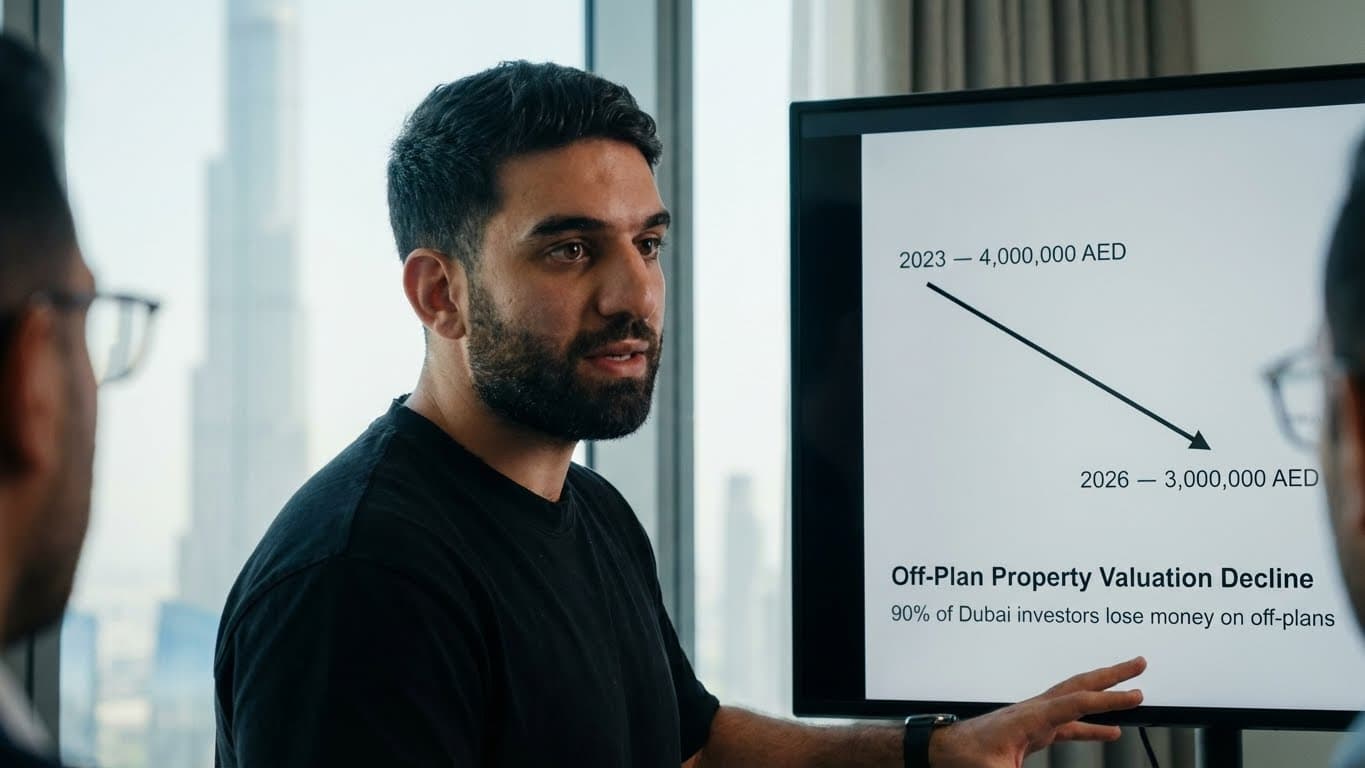
Dubai real estate agents operate on commission. The highest commissions come from off-plan developments—new projects from major developers like Emaar, DAMAC, Sobha. These pay 5-7% to the selling agent.
Secondary market properties—existing buildings you can actually see and evaluate—pay 2%.
Guess what agents pitch?
Off-plan is speculation, not investment. You're paying retail pricing with developer margins baked in. Delivery is three years out with construction risk. "Projected" yields come from marketing brochures, not operating history.
I hate 99% of Dubai agents. They don't understand investor pain points because they've never been investors themselves. They sell what pays them, which is often the worst possible allocation for your capital.
The strategy that actually works is the opposite of what they pitch.
The Strategy: Undervalued Properties in Prime Locations
High returns in Dubai come from a simple principle that agents hate:
buy ugly apartments in beautiful locations.
Prime Locations Only
First, the location filter. These are non-negotiable:
Dubai Marina – Established demand, beach proximity, Metro access
Business Bay – Walking distance to Downtown, strong rental demand
Downtown Dubai – Burj Khalifa views, premium rates, tourist traffic
JBR (Jumeirah Beach Residence) – Beachfront, walk-in tourist demand
Bluewaters Island – Premium positioning, limited supply
JLT (select towers) – Strong fundamentals in the right buildings
These areas have
existing demand. People relocating to Dubai look here first. Tourists book here. Corporate tenants want these addresses.
Agents will pitch "emerging areas" with "100% appreciation potential." Ignore this. 99% of those projects underperform or outright depreciate. I don't predict where demand might go—I buy where demand already exists.
Older Towers, Not New Developments
Within prime areas, target buildings that are 8-10+ years old.
Why? Because Dubai buyers are obsessed with "new" and "luxury." They chase the latest development, the shiniest tower, the most prestigious address. This creates pricing inefficiency in older buildings—perfectly good structures in premium locations trading at discounts because they're not the newest thing.
I've never understood this mentality. As an investor, I want value—not prestige. Older towers in prime locations offer both.
Buy in Poor Condition, Renovate to Premium
Within older towers, target units in poor condition. Dated finishes. Worn fixtures. Sellers who've neglected maintenance.
These units sell at 10-15% below comparable apartments in the same building. Nobody wants to deal with the hassle of renovation. That's your opportunity.
Let me show you what this looks like in practice.
Real Example: Before and After
One of my recent acquisitions in Business Bay. Two-bedroom, 15 minutes from Burj Khalifa, 5 minutes from Business Bay Metro.
Before:
Walls damaged, paint peeling
Bathroom ceiling literally falling off
Bathtub in poor condition
Required three pest control treatments
The kind of unit most buyers walk away from
After renovation:
Complete bathroom rebuild—removed bathtub, installed premium shower
New gypsum ceilings with modern lighting
All doors factory-painted white
Full furnishing: quality furniture, artwork, carpets, curtains
Wardrobes repainted to match
The result: 11.5% net ROI after all fees, service charges, and operating costs. Not revenue—profit.
Another unit I acquired in similar condition:
14% net ROI. The market timing was favorable, but even in a downturn, this property would generate 10% minimum.
This is what no agent will show you. They want to sell you polished off-plan renders. I buy properties that look terrible and transform them into premium rentals.
The Blended Rental Strategy
Once you've acquired and renovated correctly, the operational strategy determines whether you achieve 7% or 12%+.
Dubai is highly seasonal. Understanding this is critical.
Peak Season: Short-Term Rentals (December–March)
December through March, Dubai floods with tourists and business travelers. Weather is perfect. Events are constant. Demand spikes dramatically.
During peak season, we operate on short-term rentals—nightly and weekly stays. This captures the maximum rate per night when demand is highest. A unit that rents for 400 AED/night in low season can command 800-1,000 AED during peak.
Off-Peak: Mid-Term Rentals (April–November)
Summer months see reduced tourist traffic. Rather than chase short-term bookings at depressed rates, we shift to mid-term rentals—one to six month contracts.
Mid-term tenants include corporate relocations, project professionals, families exploring Dubai before committing long-term. They pay premium over annual leases but provide stability during slower months.
Why Not Long-Term?
Long-term rentals (annual contracts) are a trap for serious investors. I've covered this extensively elsewhere, but the short version:
Dubai tenant laws heavily favor occupants
You cannot evict a tenant who wants to stay 3-4 years
Eviction requires 12 months' notice and proof you'll sell or occupy
Tenanted properties sell at significant discounts
My first tenant was a local who didn't pay for five months—and I couldn't do anything about it
The blended strategy (short-term peak + mid-term off-peak) maximizes yield while maintaining asset control. You're never locked into a multi-year lease. You can adjust pricing to market conditions. You can exit vacant at any time.
The 6-Step Process
Here's the complete cycle:
1. Source Undervalued Properties
Target older towers (8+ years) in prime areas. Look for units in poor condition. Use DXB Interact to verify transaction history and ensure you're buying 10-15% below comparable sales.
2. Prime Locations Only
Dubai Marina, Business Bay, Downtown, JBR, Bluewaters, select JLT towers. No exceptions. "Emerging areas" are speculation, not investment.
3. Renovate to Premium Standard
Full renovation: bathrooms, ceilings, lighting, paint, doors. Quality furnishing that photographs well and commands premium rates. This is not optional—it's where your ROI premium comes from.
4. Optimize Through Blended Strategy
Short-term rentals during peak season (December–March). Mid-term contracts during off-peak. Dynamic pricing across all periods. No long-term annual leases.
5. Professional Operations
This is where most investors lose money. Management companies in Dubai try to profit from you, not for you—overcharging on maintenance, skimming on bookings, charging 3x for items that cost 1x.
I brought everything in-house after getting burned twice. Every detail matters: cleaning quality, maintenance costs, guest communication, turnover efficiency. Professional operations can mean 20-30% difference in net yield.
6. Refinance and Scale
Once you have stabilized, cash-flowing properties with documented income, Dubai banks will finance up to 80% LTV on refinance.
The playbook: buy cash → renovate → stabilize → document income → refinance → redeploy capital → repeat.
Your properties pay for themselves while you extract equity to acquire more. Connections matter here—the right banking relationships get better terms.
Why This Works for $10M+ Investors
This strategy isn't for everyone. It requires:
Capital to deploy: $1M+ to start meaningfully, ideally $3-5M+ to build a portfolio
Patience: This isn't flipping. We buy and hold—assets you never sell
Operational capacity: Either build your own or find a partner who operates properly
Network: Connections to banks, contractors, and deal flow matter significantly
But for investors who fit this profile, Dubai offers something increasingly rare:
a safety net.
Not your primary wealth engine—but a reliable, tax-free cash flow that sits outside the systems designed to erode your returns. A USD-denominated asset base that compounds without friction. A jurisdiction that treats capital well regardless of what happens elsewhere.
My Dubai portfolio is my smallest. It's also my most reliable. 10%+ net returns, zero tax leakage, complete liquidity, no political risk.
For investors who've built wealth in hostile systems, that's worth the operational complexity.
The Valuation Opportunity
One final point: Dubai is still undervalued relative to comparable markets.
The same quality of property costs:
Half the price of Mumbai
One-quarter the price of New York
Significantly below London, Singapore, Hong Kong
For the level of infrastructure, safety, and lifestyle, Dubai property remains cheap by global standards. I expect my portfolio to double in value over the next several years—not through speculation, but through market normalization.
That's upside on top of 10%+ cash yields. Tax-free.
Next Steps
This strategy is specific to high-net-worth investors ready to deploy meaningful capital. If that's you—and you're interested in building a Dubai safety net—I'm happy to discuss specifics.
This is investor-to-investor. No agent commission plays. No off-plan pitches. Just the framework that actually works.