Every Dubai STR operator eventually does the same math: multiply last month's Airbnb payout by the fee percentage, and wince. Then they ask the obvious follow-up — why not just go direct and keep it all? The honest answer, from someone actually running a mixed-channel portfolio, is more interesting than either extreme.
Here's what each channel really costs, what our own booking pipeline looks like right now, and how we decide where a new listing launches first.
What Each Channel Actually Costs You
As of late 2025, Airbnb moved almost all hosts onto a flat host-only service fee of roughly 15.5% of the booking subtotal, deducted automatically from payout — a shift from the older split-fee model where hosts paid closer to 3% and guests covered the rest. Booking.com's commission runs on a wider band, typically somewhere between 10% and 25% depending on country, property type, and whether you're enrolled in a visibility program, averaging out around 15% for most hosts. Direct bookings carry no platform commission at all — just standard payment processing (roughly 2-3%) and whatever it costs you to actually generate that direct demand, which is the part hosts tend to leave out of the comparison.
None of these numbers are fixed forever, and Booking.com in particular negotiates rates property by property — treat the above as a current benchmark, not a contract term, and confirm your own rate in each platform's extranet.
What Our Own Channel Mix Looks Like Right Now
Rather than quote an industry-wide average, here's the actual split across our confirmed booking pipeline this year: just over 63% of gross booking revenue is currently running through Airbnb, about 20% through Booking.com, and the remaining roughly 16% split between our direct-booking site and manually-arranged stays.
The more useful number is what that mix costs us blended. Our channel-fee spend works out to roughly 6% of gross fare across the portfolio year-to-date — well below the 15%+ sticker rate either OTA charges on its own. That gap isn't a trick; it's the direct arithmetic result of not having 100% of revenue sitting on the highest-fee channel. Diversifying channel mix doesn't just add booking sources, it mechanically lowers your blended distribution cost.
Why We Don't Go All-In on Direct
If direct bookings carry no commission, why isn't every unit 100% direct? Two reasons, and both are about demand generation rather than fees.
Discovery. Airbnb and Booking.com are still where the overwhelming majority of Dubai STR searches happen. A brand-new listing with zero reviews has no organic way to appear in front of that search volume — a direct-booking site only works once you already have an audience to send to it.
Review velocity. New listings need review count and rating fast, and that mostly happens on OTA volume. We've watched this play out on our own nine directly-bookable properties across Dubai Marina and Business Bay — every one of them built its guest trust on OTA reviews first, and only pulls meaningful direct traffic now that repeat and referred guests know exactly what they're getting.
The Framework We Use When Onboarding a New Property
New listing, first 60-90 days: OTA-first, usually split across both Airbnb and Booking.com to maximize exposure while the listing has no track record. Pricing stays aggressive enough to earn the first 10-15 reviews quickly — this is not the phase to protect margin.
Once reviews and rating are established: start actively routing repeat guests, referrals, and corporate contacts to a direct-booking page or tracked link, while keeping the OTA listings live and fully priced (never neglected — an inactive-looking OTA listing loses search ranking fast). This is also the point where professional multi-channel management starts to actually pay for itself versus running one platform manually.
Ongoing: watch the blended fee number, not any single platform's rate. If Booking.com is bringing genuinely different guests than Airbnb (different nationalities, different booking windows), that diversification is worth more than chasing the platform with the marginally lower headline commission.
Common Questions on Dubai STR Channel Mix
Is it worth building a direct booking site for one or two Dubai units?
Usually not yet. Direct booking pays off once you have enough repeat guests, referrals, or corporate contacts to actually send somewhere — a site with no traffic source doesn't out-earn OTA visibility on its own. It becomes worth it faster once you're running several units under one brand, since the audience-building cost gets shared across all of them.
Does listing on both Airbnb and Booking.com risk double bookings?
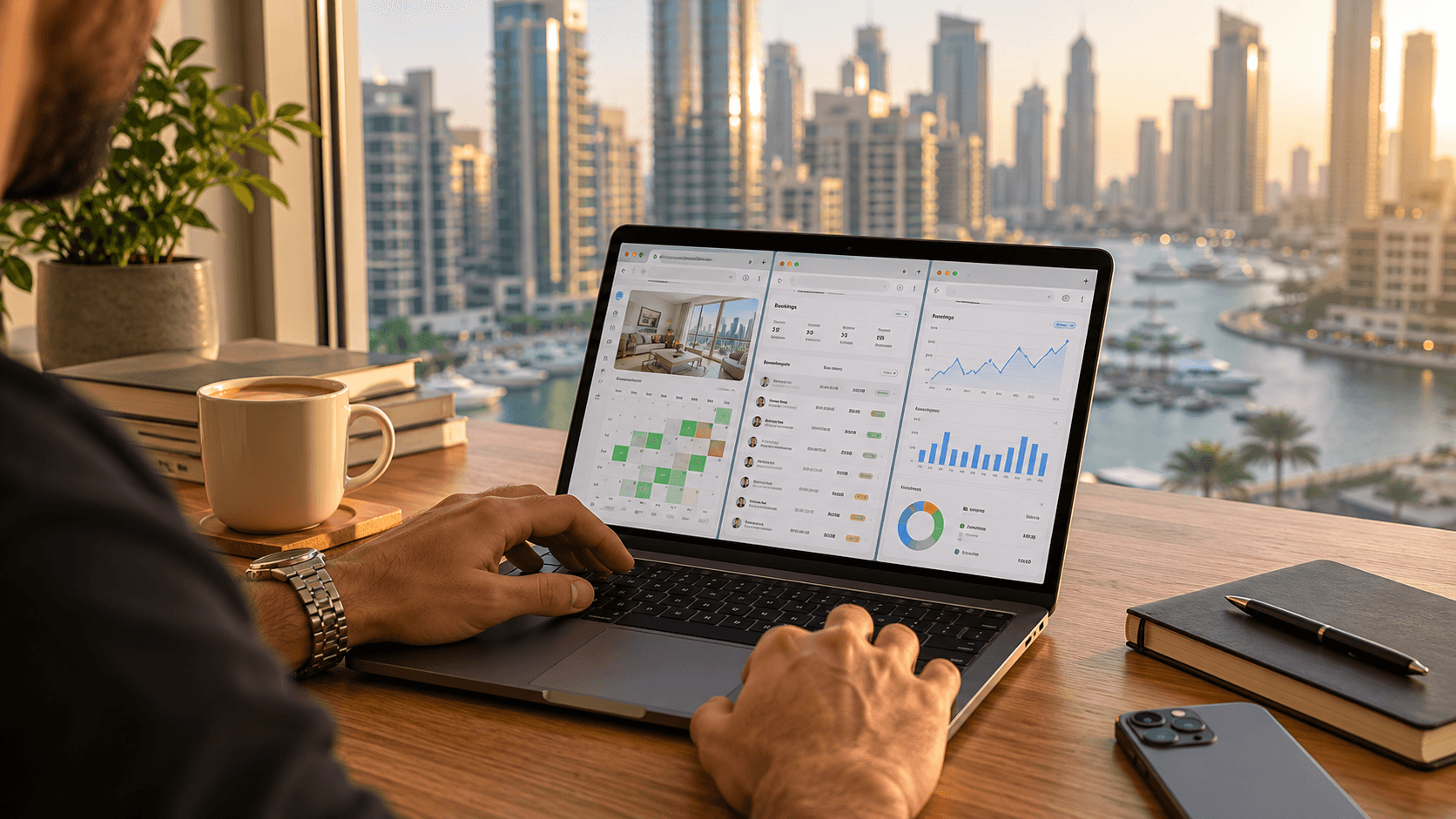
Only if your calendars aren't synced properly. This is a solvable operational problem, not a reason to avoid multi-channel listing — most professional PMS setups (including how we run our own portfolio) sync availability across every channel in near real time specifically to prevent this.
Which channel brings the best guests for Dubai STR?
There's no universal answer — it depends on your property type and area. Broadly, our own experience is that Booking.com skews toward regional (GCC) travelers and shorter lead times, while Airbnb brings a wider international mix. Direct and referral guests tend to be repeat visitors or corporate stays with the least friction. Property-specific results vary enough that we'd recommend tracking your own channel-by-channel guest profile rather than assuming ours transfers directly.
Should a brand-new operator skip OTAs entirely and start direct-only to avoid fees?
We wouldn't recommend it. Without OTA search visibility and review volume, a brand-new listing has no realistic way to generate its own direct demand yet. The fee avoidance isn't worth the empty calendar it usually produces in the first few months.
Reviewing Your Own Channel Mix?
We manage pricing, listing distribution, and channel strategy across our own multi-platform portfolio year-round — happy to walk through what a healthier mix could look like for your units.